
Chain growth phases to maximize return on development
“You have to know it before you can grow it.”
Scott Bedbury, brand manager for Nike and Starbucks
|
||||
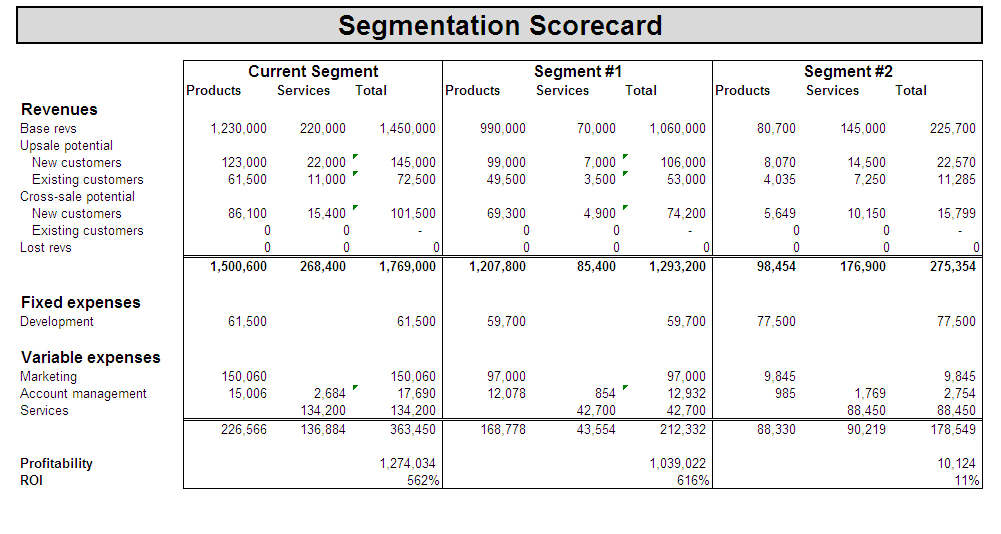 an example of a segment scorecard (click to enlarge) an example of a segment scorecard (click to enlarge) |
||||
|

Objective: Identify a chain of viable segments to maximize customer growth with the least development work.
Benefits: Advance market penetration through logically adjacent segments, which rapidly grow revenues and market mind share.
Silicon Strategies Role: Map segments using structured criteria, creating a long-range market dominance plan.
Market segmentation analysis is the science of dividing a large market into small, manageable pieces that can be prioritized and dominated.
Segmentation of markets is non-trivial. Most markets are so large that it is financial suicide selling to the entire market at once. Rare is the product that meets all needs of all buyers in a market. Market segmentation allows companies to dominate one part of the market, and from that firm foothold dominate each new market segment in a logical sequence.
A market segment is a group of customers that share common needs, desires, motivations and buying patterns. Buyers in a one market segment communicate with one another and require peer-to-peer references before buying. Carefully identified market segments create self-referencing “sub-markets” that are easier to sell into, create barriers to competitors, and make future growth even easier.
Failure to segment markets is fatal. Imagine selling one copy of your product to one person in each country. How would these individuals reference other people in their country? Only a handful of individuals in each country would be influenced by their neighbors. Geography, language and common communications would prevent explosive exposure of your product.
Likewise, product requirements and demands are different in each market segment. By initially focusing on only one or two market segments, you complete a whole product for those market segments and thus create compelling reasons to buy. Then, and only then, will your products experience rapid market growth.
The science of market segmentation requires examining all possible market segmentation models and selecting the one that meets several specific criteria. Silicon Strategies Marketing market segmentation analysis consultants guide your management team through the decision processes leading to cleanly defined and prioritized market segments. The steps in our process include the following:
- Review market segmentation and why it is important
- Review the goals for the market segmentation process
- Identify possible market segmentation models
- Review associated corporate or product objectives
- Review each market segmentation model against six essential criteria
- Select a market segmentation model, filtering those that are not viable
- List how prospects would be identified and approached
- Compare the selected market segmentation model to product life-cycle
- List the expected market segments within the model
- Confirm that market segments are self-referencing and addressable
- Prioritize market segments for market dominance
Contact Silicon Strategies Marketing for a telephone consultation about market segmentation analysis and how to conquer your markets one segment at a time.